Saturday, August 7, 2010

Bath—It’s the Water

By Claire
August 5
I thought nothing could impress me by this time. I was wrong. Bath, located in Somerset, England, is not to be missed. It has the only natural hot springs in Britain. We enjoyed every minute of our first day here. We started out early, a seven minute bus ride from our campground, Newton Mill Holiday Park Camping, €33.60. Much to our delight, we found the city almost empty which gave us the opportunity to walk around and see it in the early morning light without the crowds. In fact, we were the first ones through the doors of the Roman Baths.

I think the area around Bath has had several distinct eras: Pre-Roman, Roman, pre-Georgian and Georgian. The medicinal properties of the waters were alleged as early as pre-Roman times with several competing myths. The Romans had no natural explanation for the heated waters and attributed supernatural significance to them. Our guide explained that the probable natural explanation is that rain fell several hundred miles away 10,000 years ago and seeped through the porous rock layers of the area, only to be heated and forced up from nearly 100 yards deep, here, from the time of recorded history, in the amount of approximately 1 million liters a day! The Romans came so often to Aquae Sulis to “take a bath” that it finally became known as Bath.

Bath Abbey was the site of the coronation of Edward, first King of all England, in 973 AD. The ceremony, created by the Archbishop of Canterbury, has remained virtually unchanged to the present day.

For centuries, Bath was forgotten as a spa. Then, in 1687, the previously barren Queen Mary bathed here at Cross Bath, became pregnant, and bore a male heir to the throne. Bonnie Prince Charlie was her grandson and the defeated leader of the Scottish forces at the Battle of Culloden, in 1746. If not for the baths, the battle might never have occurred. Sometimes things come full circle for us.


Later, Queen Anne found that the water eased her painful gout. Word of the waters spread and high society soon turned the place into one big pleasure palace.


Colannaded Street


The baths include an audio tour with several choices: historically informative; Bill Bryson giving his impressions; or a version especially for children. The museum surrounding the baths was wonderful. There were video re-enactments of Romans going about their daily lives and that, as well as the fantastic HBO series, Rome, that we watched before our trip helped to bring it all to life.

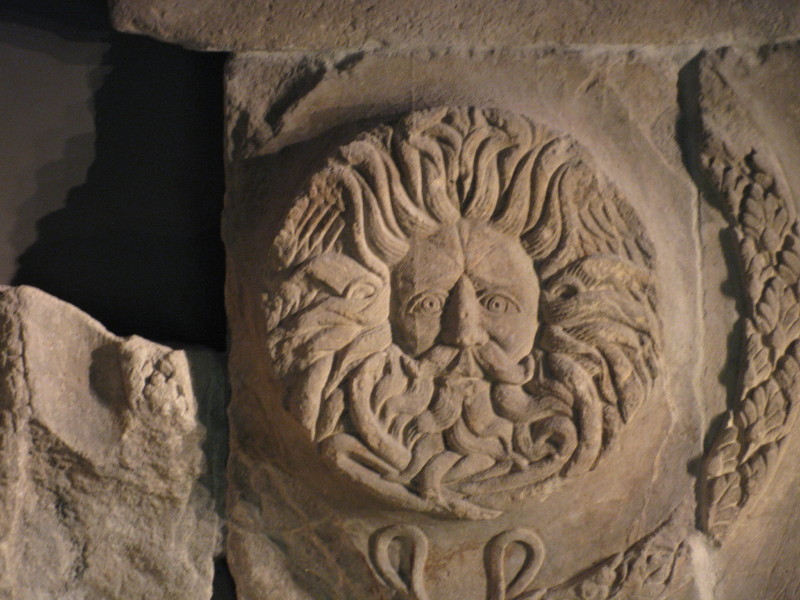
This Celtic face was part of a pediment at the entrance to the baths. The image is unique in Britain. On the one hand, it is believed by some to be the head of Minerva, goddess of the hot springs, because of the snakes in the beard; however, since the image is male, it cannot really be Minerva—universally acknowledged to be female.


This 2,000 year old skeleton was found inside the lead lining of a coffin (the coffin did not survive). Archeologists did a reconstruction of the man’s head and determined that he was wealthy and ate a good diet that included honey, as indicated by several cavities. They also determined that he was Mediterranean and over the age of 45.


It was a custom of the time to formally curse those who had wronged you. Many Romans would write out a curse on metal to be presented to the goddess Minerva. I was impressed with how petty their problems were. Over 100 hundred curses have been recovered from the spring by excavation. Curses were folded or rolled before they were thrown into the spring. If the victims were unsure as to the identity of the culprit, they would often include a list of the “usual suspects” to help the gods appropriately apply the curse.

“To Minerva the goddess of Sulis I have given the thief who has stolen my hooded cloak, whether slave or free, whether man or woman. He is not to buy back this gift unless with his own blood.”

“Docimedis has lost two gloves. He asks that the person who has stolen them should lose his mind and his eyes in the temple where she appoints.”

One of the curses is the only surviving fragment of British Celtic language in the world. Unfortunately, it is illegible.

The pools are green with algae and you are warned not to drink the water. The algae only became a problem after the Romans left, the roofs collapsed, and sunlight hit the water. They are lead-lined and to this day they are still watertight!


This overflow channel with the buildup of minerals is the original Roman design.


Finishing the tour of the baths in just under 90 minutes, we walked to the Pump Room to meet up for a 2 hour walking tour. We were pleased with ourselves for beating the crowds that had now appeared.


The Mayor’s Corps of Honorary Guides, led by volunteers who want to share their love of Bath, is free, no tips and offered year round. Clive was a great guide and we were immersed in the history of this amazing Georgian town (so named for the architectural style of the buildings during the reign of 4 Kings named George in the 1700’s).

Georgian House, around 1747. Note the symmetry: there is always a distinctive center—for example, double pillars or a pediment, surrounded on each side by (ideally) identical features.


In order to keep to the properly balanced Georgian (English for ‘neoclassical’) style of this house, the windows on the ground and second floor next to the central doorway and window are fake.


The small jutting building made of slate with the small open window is called a hanging loo. This was considered quite modern and some people put one in as a place of privacy to use the chamber pot.


Clive told us that in 1956 a clean air act was imposed. The townspeople were no longer allowed to burn coal and the buildings were painstakingly cleaned. He’s not sure why, but one building was left untouched, giving us the chance to see how they had looked.


We finished our tour on the Pulteney Bridge, shop-lined like Florence’s Ponte Vecchio, overlooking the River Avon.


Rick Steves says that “Proud locals remind visitors that the town is routinely banned from the ‘Britain in Bloom’ contest to give other towns a chance to win.” We managed to overlook the 2 million tourists per year to this town of 85,000 and managed to thoroughly enjoy ourselves.

By now we were ready for a break and some food. We had made the decision to skip lunch and go directly to Afternoon Tea at the famous Pump Room, an elegant Georgian hall just above the Roman Baths—a fancy tea that was well worth waiting for. Not only that, we were entitled to a taste of the curative water (£.50; free with your ticket to the Roman Baths).
We had to wait about 15 minutes—if we had thought of it, we could have made reservations. The service, surroundings, music evoking Jane Austen, and the food were all stupendous.


Water fountain


The water was warm, about 100°, and I don’t care how curative it is, I did not want to finish it.

Feeling great about our day and with the sun shining, we decided to head back to Homer before exhaustion set in. We walked past the beautiful Bath Abbey, glowing in the sunshine—I had to shoot fast to capture the sun.


In Britain are
hot springs
adorned with sumptuous splendor
for use of mortals.
Minerva is patron goddess of these.

~ Solinus 3rd Century AD

Thursday, August 5, 2010

Hay-on-Wye

By Claire
August 4

It was a test of our fortitude that we finally found our campground, Moorhampton Caravan Club, €20.28. Susan took us through the villages and farmlands of Hereford—square Norman towers with arrow-slits, thatched pubs, tiny Victorian railway stations resting in a countryside of high hedges and a patchwork quilt of fields dotted with sheep.


As we bounced down a rabbit warren of roads, I was taken with the town of Hope-Under-Dinmore. What exactly does that mean? Would you say you were from Hope or use the entire name? We cut in and out of Wales and England, the River Wye separating a portion of the two countries. With a map open on my lap, the directions in the camping book, a little GPS assistance from Susan and a fair amount of cursing, we arrived at 5:05 pm, 5 minutes after closing. Lucky for us, there was a sign on the reception door letting us know we could pick any spot and pay up in the morning.

Exhausted, we collapsed with our books and went to bed early. We had a big day planned yet again for the next day, but couldn’t leave until after 9:30 when the office opened—so, getting up early as usual, we read for 2 hours.

We drove into Hay-on-Wye, “The Book Town,” with the idea of selling all our books. Fortunately, there was a huge, 400-car parking lot at the top of town. We loaded our backpacks and, hunched over with the weight of 38 books, approached the first of the 31 possible bookstores in town.

Hay-on-Wye


We sold 3 at the first shop, then most of the rest at another, Richard Booth’s Bookstore, which carries 500,000 books on all subjects. Richard Booth, in 1962, came up with the idea of turning the town into a booklovers attraction. We talked with the current owner, a woman from Marin County in California. She and her husband are retired and bought the bookstore for fun. I wish we’d had the time and the ability to browse and scoop up a few dozen more books. The shop was incredible.


With just a few of our beloved books left, mostly old ones that we had picked up elsewhere, we made our way to the local Oxfam and donated them. When I asked the woman how far Hay is from Wales, she told us we were in Wales but the grocery store down the block was in England. She has a friend whose house is in England but her backyard is in Wales. We now have an empty shelf inside Homer—we are beginning to divest ourselves of things we cannot bring home.

Driving on to our next destination, Bath, we stopped at a Welsh supermarket, Waitrose. We’ve never seen anything like it. We loved the clipboard set up to hold a shopping list. They also had handheld devices to enter the price of each of your items by swiping it across the bar code. When you’re done, you just go through the checkout, handing the device to the checker, pay up and you’re out the door. There was a place to store that on the handlebar, too. The devices are checked out at a desk in the front of the store.


Moving back into England, we crossed the bridge over the River Severn. Beautiful!


This time, we had the GPS coordinates for our campground and found it easily. It’s been far more difficult to find campgrounds in Britain. The coordinates do not always work for us—they often use minus numbers and our TomTom will not accept them. We were reminded of how much easier it was in Europe.

With our fridge and stove working again, we had one of our favorite meals, chicken with an Indian sauce over Basmati rice. The sauce is out of a jar and the rice is whole grain and boil-in-the-bag. Delicious!

Before


After


Where is human nature so weak as in the bookstore? ~ Henry Ward Beecher

Spectacular Shrewsbury

By Claire & Chuck
August 3

We really loved Wales and its gorgeous landscapes—from rocky mountain to slate covered trails to lush forests. We would have to say this country has as much beauty as any place we have visited.


We left Betws-y-Coed desperate to find a service station with LPG for our fridge and stove. The woman at the local Shell station sent us 15 miles north—the opposite direction from our destination—but we decided it was worth it. We found it—but added an hour of driving to our day. This came back to haunt us, later.

We arrived in Shrewsbury, Engand, birthplace of Charles Darwin, just about noon—frustratingly slow progress when you’ve been up since 5:30. We were now in the district of Shropshire, and noticed the difference immediately. No more dark stone and slate houses—instead, lots of red brick and half-timbered houses along the road we came in on..


Quantum Leap, a monumental sculpture and tribute to Charles Darwin, local boy.


We found a place to park along the road then ambled down the street where we stumbled upon The Mount, where Charles Darwin was born and lived until he was 11. The former home is now a governmental building with employees whose job description includes showing tourists the room where Darwin was born.

We finally found signage to the Tourist Information office; it is to our everlasting shame that we did not really research Shrewsbury. Rick Steves has virtually nothing on it. My only reason for wanting to see it is because of the Benedictine Abbey that was the setting for the Brother Cadfael mystery series by Ellis Peters (penname for Edith Pargeter).


I knew nothing of the Castle, the other Churches or the sunken gardens. But, today was one of those days when we bit off more than we could chew—late start due to late opening of the checkout office where our food was being held, an hour lost to find and purchase LPG, backroads drive to Shrewsbury, backroads drive to Ironbridge Gorge, and backroads drive to our campsite, near Hay-on-Wye in Hereford, right on the border with Wales. We blame Susan for our tardy arrival at the campground—they closed 5 minutes before we pulled up! At any rate, we shortchanged Shrewsbury and only visited the Abbey.

Cyclists defying death on the narrow—and bicyclelaneless—backroads of England.


The drive to the Iron Bridge was uneventful, though we did have our usual pangs of regret regarding Homer’s size—He is too wide and too long (especially with the bike racks) to be comfortable in either Europe or the British Isles, much of the time, when driving or parking. But, again, we had not planned well: I was primarily interested in seeing the bridge, not the 10 local museums associated with the bridge and the birth of the Industrial Revolution in the Severn Valley. So, I did not bother to tell Claire about the other opportunities, since this was “my” day to see chosen sites. However, we did not have time to spend, given that we have to make advance reservations to ensure we have a place to stay. As we have stated previously, this is a severe downside of touring in high season—much of the spontaneity of travel is scrapped.

The bridge, built in 1779, was surprisingly small, from a distance; but, by the time I had walked around it and over it, looking at its size and construction from multiple views, I was won over: It is beautiful, in its way.


We finally arrived at our campsite—5 minutes after the Reception Office closed, at 5pm! Fortunately, there are no barriers to entry and there are no keys required for access to the toilet facilities. We simply drove in, hooked up and prepared dinner. Much later, the camp warden knocked on our door to be sure we were “all right.” We are.

Rivers know this: there is no hurry. We shall get there some day. ~ A A Milne

Monday, August 2, 2010

Hiking in Betws-y-Coed

By Claire
We found the trail Denise had recommended, the Ilyn Elsi, right next to the church, just as she had said. Chuck’s comment when he read the description on the map next to the trailhead was “Naturally, she picked the most difficult one!” But, it was worth it. Steep uphill but then leveling off with beautiful forest, moss and falling down slate walls all around us.


Trailhead church


We crested the top and found the beautiful lake and masses of birds. Something set them off, and we had a sudden burst of noise and flapping wings as they soared around us, finally settling back onto their little islands.


A patch of blue! Maybe it will spread.


Beautiful mushroom; there were lots of different kinds along the trail.


The lake


The views were gorgeous and I had to ask Chuck, “Do you realize we are hiking in Wales? Did you ever imagine yourself here?” His answer? “Sure, after we met Gino and Denise.” Truly, they are the reason we are spending time here. Knowing nothing about this area of Britain, I’m afraid we might have just driven through it on our way back to England.

We’re enjoying our campground here, Riverside Touring Park, €27. It's a short walk into town, which we took this morning in search of breakfast. The campground wardens are storing our refrigerator items but don’t open until 8:30. We were on our way before 8, enjoying the quiet and the almost empty town. It’s very small and consists mostly of cafés, outdoor clothing and souvenir shops plus a couple of churches.

Some sights along the way:


Brynmawr Church, Eclwys Bresbyteraidd Cymru. I'm guessing it's a Presbyterian Church.


We found a Spar market open and selling cappuccinos and baked goods. I went for the muesli flapjack, a square of nuts, oats and fruit glued together with honey. Perfect. I don't know why they call it a flapjack. Chuck went for a chocolate brioche and a strudel. Sitting on a bench in the park, it was a splendid breakfast.

We decided to go back and get our proper hiking boots and some water before setting off on the hike. We even used our trekking poles. A good idea all around. We were very impressed with how well marked the trail was: a footprint in black and white for the lake trail and a footprint in blue and white for another. We found the markers often and it made the hike so much easier not to have to worry about taking the wrong fork in the road. I am so happy to be hiking again.


We arrived back in town to find it swarming with tourists and completely changed. No wonder early morning is my favorite time of day.

An early-morning walk is a blessing for the whole day. ~ Henry David Thoreau

Monthly Expenses for July 2010

By Chuck and Claire

Camping, €550.56
Eating Out, €359.15
Groceries, €205.41
Attractions, €222.70
Fuel, €375.24
Other transportation, €41.60
Ferries, €362.20
Hotels, €0
Misc., €156.33
Grand Total €2273.19
Daily average: €78.73
In dollars: $2727.83

Sunday, August 1, 2010

Wonderful Wales

By Chuck
After reading the Cadfael mysteries—which occur around Shrewsbury, England, just across from the Welsh Border—and having recently read The Reckoning—regarding Llewelyn II, the Prince of Wales’, attempts to keep his country free from domination by Edward III of England, I was delighted to finally set tire in this beautiful land several days ago.

This morning, we prepared to leave The Mountain on Anglesey, ate our breakfast and, sadly, took our leave of Denise and Gino—headed for Caernarfon Castle, Portmeirion and the Snowdonian National Park, en route to the charming village of Betwys-y-Coed.

Caernarfon Castle is the best preserved in Wales; it is huge, but allows you to wander almost anywhere; it is the place where Charles, Prince of Wales, was invested with his title, in 1969; it has an interesting military Museum of the Royal Welsh Fusiliers.

Caernarfon Castle


City View from the Castle


Tourists at the Castle


Investiture of Charles, Prince of Wales (1969)


Charles and Queen Elizabeth II at Investiture


The most surprising interpretive sign in the museum described how (many) wives would follow their husbands to war, receiving a very slight salary; more disturbingly, they would retrieve spoils from the fields—such as weapons, jewelry and teeth. These would be retrieved from the fallen on both sides. If someone were incapacitated, they would sometimes resort to relieving him of his life and his valuables—presumably in that order. The expectation of acquiring the spoils of war continues down to the present day—though the establishment of standing armies receiving regular pay, among other factors, has reduced the incidence of this practice greatly.

I have referred to these soldiers using a masculine gender; there was at least one exception: A woman disguised herself as a man and became a soldier, fighting alongside her husband; he was killed. Later, she was wounded and they discovered her identity; she was permitted to continue to serve; but, apparently, could only receive pay and benefits if she were married to a soldier—she was widowed several times before the end of her service.

A touching story of a woman connected to the Fusiliers recounts how she followed her husband to the front. When he was wounded, she lay by his side for 3 days, nursing him back to health; he survived and they both lived to a ripe old age—she outlived him, dying at 90.

Rain Suit at Caernarfon Castle. Does it come in a gargantuan size?


I have always wanted to visit Portmeirion, ever since I viewed The Prisoner television series in 1966-67 and discovered the shooting locale. I even suggested to another fan, who was visiting her daughter in Wales a number of years ago, that she check out the village.

Home of The Prisoner in Portmeirion: “You are Number Six”


This “Italian Village” is the extravagant creation of an architect who began a lifetime of work on it in 1925. Rick Steves says: “Surrounded by lush Welsh greenery and a windswept mudflat at low tide, the village is an artistic glob of palazzo arches, fountains, gardens and promanades filled with cafés, tacky shops, a hotel and local tourists who always wanted to go to Italy.” Walking the trails, even in the mud, was a delight.


Hydrangeas in Portmeirion—they lined the small lane into town and were everywhere around the town.


We continued on, driving through part of Snowdonia National Park; it is the second largest in Britain and has the tallest mountain in England or Wales—Mount Snowdon at 3,560 feet. Due to weather and time, we did not attempt to hike it—a couple at Caernarfon said they went yesterday and were unable to see the top. I found it lovely, though it is difficult to truly appreciate the surrounding beauty while driving on the “wrong” side of the road on narrow streets; I would say the physical beauty is a match for anything the rest of the British Isles has to offer; but, for emotional impact based on history—and the historical fiction of the Outlander series—Scotland is still a sentimental favorite.

We arrived at the campground on the edge of Betwys-y-Coed late in the afternoon—having missed only one turn and managing our turnarounds relatively quickly: Claire jumps out to ensure I don’t back into something and jumps back in once I can manage the turn; we quickly discovered that we had finally run out of LPG (Liquid Petroleum Gas); so, we cannot run our refrigerator; also, we could not cook a dinner; fortunately, the office is willing to stash our refrigeratables until we leave. We have had problems in some countries finding service stations where we could fill our LPG tank from the pump—as with Hydrogen Fuel cars; In Great Britain, the preferred method of storing cooking/heating/refrigerating fuel is in tanks that are exchanged for full ones, as needed. At any rate, we failed to find one today and there are none in the immediate vicinity. So, instead of raviolis, we had yogurt, cheese and crackers for dinner.

The final incident for today was that we seem to have lost the electric adapter that allows us to extend a second electric cord to remote power sources. This means that we either need to replace it—but, it’s expensive for occasional use—or do without: This means either parking close to the power source or borrowing another extension from the campsite wardens (neither option can be relied upon, unfortunately).


To travel is to discover that everyone is wrong about other countries. ~ Aldous Huxley