Saturday, August 21, 2010

Canterbury Tales

Above the Cathedral Gate

By Chuck
This morning was one of those rare English days when the sun was shining from first thing in the morning. We dared to believe that summer was finally with us. Needless to say, this quickly changed. The day has been overcast, with fairly constant light misting and high humidity. At least it is not cold—for the second time in 11 months we switched back from our down comforter to a lightweight fleece blanket for sleeping warmth.

We wimped out and rode the bus into town, rather than hike or bike it. They made it so easy it was hard to refuse: Walk outside the campground and flag down the next bus. Of course we had to pay £2.50 each for a return ticket—that’s English for round trip. I am glad we did it, especially since we carried back perishables on the return.

We really only aimed at 3 definite activities, today: Wifi access, walking tour of the city, and meds for me.

Second Breakfast—Cappuccino and Danish


We arrived early and found a coffee shop that had free Internet access. Our netbook did not perform well, but we eventually were able to upload the blog. While Claire finished the uploading of pictures and the blog posting, I went to the Welcome Center to purchase tickets for the walking tour. Later, when we finally located a pharmacy we were startled to find that England does not honor prescriptions by foreign doctors—those not in the English registry. In France, we had absolutely no problem with filling our American prescriptions. As they say, cultures differ.

The River Stour


Dunking Stool Along the River Stour—They Had Their Witchhunts Before We Had Ours


I am shocked, shocked I say, to find that there is no actual proof that Chaucer ever visited Canterbury—at least that is what Martin, our guide, said. I guess that shouldn’t make Canterbury Tales any less memorable.

The Unwashed Masses in front of OUR gate


I know of Canterbury from the story of Thomas à Becket. What we have heard is mostly the myth; the truth is more elusive and, presumably, less exciting. Edward II needed to appoint an Archbishop of Canterbury; he chose his carousing buddy, Thomas. The goal was to eliminate opposition to his plans to have a single code of criminal law for civil offenses, rather than the then-current two-track system of separate sets of laws for ecclesiastical and secular offenses. When the church was finished with meting out its punishments, Edward thought it should turn the offender over to civil authorities. Becket underwent a radical change after receiving his appointment and fought his King to maintain ecclesiastical authority, eventually prompting Edward to ask “Will no one rid me of this meddlesome priest.” Several Knights were up to the task and murdered Becket before fleeing the country.

Naturally, miracles were quickly ascribed to Becket and pilgrimages became commonplace. He was fast-tracked to Sainthood in 3 years, which may set a record of some kind. The far east end of the cathedral is occupied by an apse chapel known as the Corona ("crown"), because it once housed the relic of St. Thomas' head. For many years, the iron-rich (and red) water of the river was touted as red with Becket’s blood.

The truth about Becket may have more to do with hubris than with religious zeal. “As Archbishop of Canterbury from 1162, Thomas Becket excommunicated the archbishop of York and two other bishops in November 1170. The excommunication of the bishops by Becket was his response to the coronation, in June 1170 by the archbishop of York, of the young son of Henry II who was a token co-regent until his father's death in 1183. Becket had been in exile for earlier oppositions to the king, and this brought matters to a head. In Becket's eyes crowning the king was a Canterbury privilege. He agreed terms with Henry and returned to England with the intention of punishing those who had infringed that privilege. When the excommunicated bishops complained to the king, then in Normandy, Henry II's angry words prompted four knights to cross the Channel and kill Becket in his own cathedral on 29 December 1170, a murder that shocked Christendom. Little more than two years later, in February 1173, he was canonized by Alexander III.” In another episode, “When Thomas went to France in 1158 to negotiate a marriage treaty, he travelled with such pomp that the people said: ‘If this be only the chancellor what must be the glory of the king himself?’"

One of the most interesting natural phenomena we encountered was a hybrid American/European Plane tree with a very large trunk. We know these as Sycamores, but Martin said their Sycamores are a distinct species from ours.

Hybrid Plane Tree on Cathedral Grounds


We visited the King’s School. The school became possible when Henry VIII appropriated all properties of the Catholic Church in England and established the Church of England. Those buildings that were not destroyed were repurposed in various ways. One became this school. Originally, the school was for poor boys; they were trained to sing in the choir and learned two musical instruments; there was no other way in that period that such students could receive such a musical education. Today, the same schooling is £25,000 per year. Let us consider a few of the former King’s School Choir boys— Christopher Marlowe (playwright), William Harvey (circulation system), Somerset Maugham (author), Carol Reed (Director—The Third Man), Field Marshall Montgomery (WWII), and Michael Foale (first British astronaut). Somerset Maugham, when he became famous, was asked by the school to fund a scholarship for boys like him who were poor and worthy. They couldn’t find anyone willing to take the scholarship, apparently, so he built a science lab instead. His request was that his ashes be buried under the window upon his death, within sight of the headmaster.

Christopher Marlowe is famous for authoring Doctor Faustus and other Elizabethan era plays. Some claim he is the actual author of the works of Shakespeare—this is often on the grounds that, lacking much formal education, Shakespeare could not have written his works. Perhaps they haven’t really thought through the meaning of ‘genius’.

The building now known as the Mayflower Pub, is the location where the contract to convey the Pilgrims from the port of Plymouth to the New World was actually signed. Since the Mayflower Compact was devised on that voyage, England can claim a role in the development of democracy in America.

Mayflower Pub


Our first view of Canterbury Cathedral was through the Cathedral gates; this view was so restrictive that we were unimpressed, thinking we were seeing the full site. Wrong. This is among the largest cathedrals in England; it is enormous. Originally founded in 602 AD by St. Augustine—of England, not of Hippo—it still functions as the cathedral of the Archbishop of Canterbury, the leader of the worldwide Anglican Communion. We were surprised to learn that the bulk of the stone used in its construction was brought in from France—the local stone cannot be squared easily and is unsuitable as the primary substance for building construction.

Canterbury Cathedral


We were surprised to find that many of the buildings in the city that seemed to be of brick construction actually had only a brick tile facing—bricks added to the underlying wood construction would have toppled the buildings.

Tiles on Building Facings


One building was leaning: Attempted renovations many years ago began to distort the structure; it was shored up with steel before it collapsed; but, the chimney did eventually implode, leaving the rest of the house intact; however, the interesting doorway was retained.

Bent House


The second story of the overhanging building down the street, on the right, was a dancing school until about 50 years ago. Only the wooden floors gave it the flexibility to withstand the movement.

Street With Old House


During the early years of mass pilgrimage to the Cathedral, special accommodations were constructed for richer pilgrims; they were able to stroll down covered walkways to rooms with fanciful names—for example, Heaven and Paradise. Poorer folk at in a group mess at the other end of the walkway.

Heaven and Paradise Rooms (in the rear, left corner of the image) for Richer Pilgrims, in Descending Order of Height


As usual, it is always awe-inspiring to see buildings that were rebuilt in the late medieval period—in this case, anywhere from the 1200’s to the 1400’s. It is really quite humbling to those of us from the New World.

The original abbey had its own well and a complete plumbing system. The water had a specific order to follow, from kitchen to monks bathing and ending with the 55 seat latrine, from which the water spewed into the dump for the city—trust me, this latter spot is not the place you wanted to live in Canterbury.

Well for the Abbey


Remains of a Latrine for 55 Persons


The change in the weather has been interesting. We are getting less actual rain, though it constantly threatens, and it misted fairly steadily, today. The wind is stronger than usual, day and evening. We are aware of the humidity at this point—something we have not been conscious of for some time. But, we have not really been cold; in fact, we find ourselves quite warm whenever we exert ourselves—walking to the bus, for example.

The Streets of Canterbury at Mid-day


Pizza with Salad in the Donut Hole Center


In closing, I admit to being disappointed in this, our last campground in England. It is certainly serviceable; but, the facilities are old and it is crowded—it has no real separation between pitches; it has a little bit of the feel of a parking lot. I would have preferred to end on a high note.


Any nation that thinks more of its ease and comfort than its freedom will soon lose its freedom; and the ironical thing about it is that it will lose its ease and comfort too. ~ W. Somerset Maugham

Sissinghurst, Kent

By Claire
Another dream come true took place for me today: visiting the castle gardens at Sissinghurst, another wonderful National Trust site. This internationally renowned garden was created by Vita Sackville-West and her husband, Sir Harold Nicolson around the surviving parts of an Elizabethan mansion. There were three plant themes in the dozen or so gardens: seasonal, type and color. They comprise small enclosed compartments, with color throughout the season, resulting in an intimate and romantic atmosphere. The new vegetable garden—enormous—supplies fresh vegetables and fruit to the licensed restaurant. We saw a sign selling the produce as we were leaving.

Vita and Harold had an unusual marriage—they loved each other dearly and each had other partners with the complete acceptance of the other. They also had two sons. Their eldest, Nigel, inherited the property when his mother died (she had the money) and with his father’s approval, gave it to the National Trust.

Vita and Harold in the Thirties


We arrived 10 minutes after it opened and were directed to the very far end of the large car park. We could not believe how many people were already there! This is the most popular garden in England—and is reflected in their admission prices: £9.50 each plus £2 for parking--all free for us as members. Hurrying to the Tower, we were lucky to beat most of the crowd. It was built in 1560, and when Vita and Harold bought the property it was relatively unscathed. There were broken windows in the room she chose for her study and birds were nesting inside, but they cleaned it up and replaced the windows. I took a sneak picture of the room through the metal bars keeping us out but it doesn’t really show how wonderful it is. Inside this round room is her writing desk and in an alcove are shelves wall-to-wall with books. There is also a sofa for relaxing or sleeping. I was lucky to be able to view it by myself for several minutes before anyone else came along. Even when the room was her inner sanctum, others were rarely admitted to it. The other rooms in the tower held exhibits about the gardens and the history of their lives.

Entrance


The Tower


Vita's study


The top of the tower afforded commanding views of the entire area and was a great way to start the tour. We had trouble finding the round sculpted-hedge garden on the ground.


Mostly we just wandered from area to area, admiring the flowers and plants, the moat and statuary. There are beehives, wells, gazebo-like structures and a small, round memorial building that was put up by Harold’s sons upon his death.


The moat


Vita and Harold later in life


Vita and Virginia Woolf were close friends. There is a bust of Virginia in the library and her book, Orlando, was a thinly disguised biography of Vita. They met in 1922 and were friends until Virginia’s suicide in 1941. Vita, herself, was primarily a poet and author of fiction. Harold was an historian, diplomat, author of nonfiction and a radio personality.

Driving through the countryside, we saw many of these Kentish Oasthouses and wondered what those things on the top were. They are called cowls and the houses were where hops were dried. The cowls rotate with the wind and act as chimneys to draw off the acid ‘reek’ from the drying hops and shield them from the rain and downdraft.


I have fallen in love with Kent, an area of England I am not familiar with. We are currently in Canterbury, at the Canterbury Camping and Caravanning Club Site. It’s so huge, we even have a street name; ours is Park Lane. The architecture we saw as we drove to Sissinghurst, about an hour west of Canterbury, is unique—lots of orange brick with orange tile roofs. It all looks very old and the roofs are sweeping and curved. I wish I could have gotten some photos but it’s hard from a moving vehicle and park? Forget about it—these were tiny towns.

This is similar to what I’m talking about.

It’s very pastoral and bucolic, which means it also has a strong smell of manure. But…the sun is out and it’s beautiful. Have we finally found summer?

In 1756 Sissinghurst was let to the Government as a prison-camp for French prisoners of war and for the following seven years was occupied by more than 3,000 inmates. Some of the graffiti from these prisoners remains. So much damage was done to the building that by the end of the occupation two-thirds of the building had been destroyed.

We strolled back to Homer for lunch, discovering a flat tire. Fortunately, I have the AA Club phone number for every country on my Kindle; we have a phone and I gave them a call. The woman I spoke with wanted to know if I was a member. I told her we were AAA members and wondered about reciprocity. She didn’t think so but told me she would check and call me back. About 10 minutes later I received a call from a guy who asked for our AAA card number and then proceeded to ask questions about the size of the camper, where we were, etc. I asked him what it would cost and he told me “no charge.” We went ahead with lunch then pretty much sat and relaxed. I read, keeping an eye out, and finally—an hour and a half later—they showed up. The tire was changed and we were on our way. It could have been so much worse. I have visions of us on the side of the motorway with cars roaring by or even worse, losing control. A flat in a car park is perfect. And, having a phone was very helpful.


I worshipped dead men for their strength, forgetting I was strong. ~ Vita Sackville-West

Thursday, August 19, 2010

The Mean Streets of Greenwich


By Claire
Our plan was to visit the prime meridian—it was only a few train stops from our campground—then split up, each going our own way.

I guess I was surprised by the crowds which included a large tour group. But, we managed to enjoy it anyway and it was free!

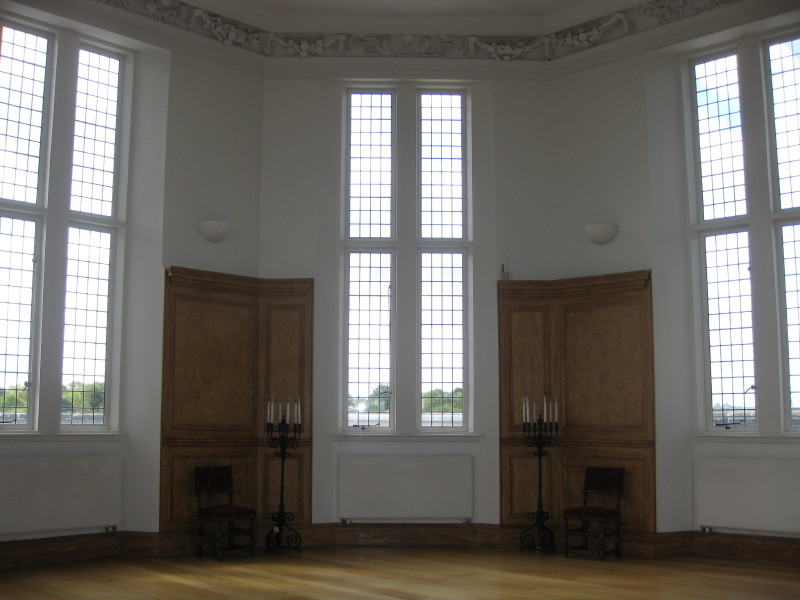
It’s quite a hike up to the Royal Observatory which offered stunning views of London and many exhibits including a camera obscura, the house of John Flamsteed, the first Royal Astronomer, a planetarium and of course, the Prime Meridian.


We started with the remains of a 40 foot telescope, built for astronomer William Herschel, who became famous for his discovery of the planet Uranus in 1781.


The telescope was the largest in the world and cost over £4,000, paid for by King George III. Sadly, the Herschels did not use it for much serious astronomy since it was difficult to set up and maintain. William’s son dismantled it in 1840. Most of the tube was destroyed when a tree fell on it 30 years later.

I was intrigued by the Camera Obscura, which means “darkened chamber” in Latin. In a darkened room with a pin hole in one wall, an upside-down image of the world appears on the opposite wall. Developments through the centuries with mirrors and lenses transformed the Camera Obscura from a darkened room into a portable instrument which was the forerunner of the modern camera. After our eyes adjusted to the pitch black, we were able to see a view similar to the photo of the city I took, above. We had a Camera Obscura set up in the Arboretum as a student project a few years ago. It was interesting to compare them. There was very little difference.

The Prime Meridian is an imaginary line running north-south through Greenwich. In 1884 the line was named as the world’s Longitude Zero by the International Meridian Conference.


We visited Flamsteed’s house dating from the late 17th century. The observatory at the top was spectacular.


This is a photo of what it would have looked like.


We went through a museum with time pieces and longitudinal mechanisms, finally deciding to walk back to the train station for our farewell. We always think we’ll be able to see something in an hour. We’re always wrong!

Looking at the sky darkening as we walked, I decided to head back to Homer while Chuck made his way to the British Museum for another visit.

Having a conversation across the tracks while waiting for our trains.


British Museum…Again
By Chuck

I just couldn’t bring myself to leave England without pursuing activities of “socially redeeming value” for as long as I could; so, I pondered the alternatives and decided to re-visit and further explore the British Museum. I thought I would try some of the free eyeOpener tours, thinking this would help me navigate a confusing building layout; but, I had already missed one tour, and by the time I got to the next tour’s starting point, either it had already left or there was no interest; since I didn’t really care about North America anyway (in a museum artifacts kind of way, that is), I decided to continue my exploration of the exhibits relating to Buddhism.

I was reminded of these by perusing the brochure on A History of the World in 100 Objects; so, I headed off to room 33 to learn about the religions of India. I had seen some of this before, but I enjoyed the chance to refresh my memory and enjoy these beautiful objects.

By the time I was finished here I was ready to either leave—I was tired—or have a cappuccino. After my so-so coffee, I was reinvigorated and ready to oh-so-briefly review the ancient worlds of Greece, Rome, Lycia, Assyria, Mesopotamia and Egypt. The highlights were the Rosetta Stone, the sculptured guardians to the Palace of Sargon, the Elgin Marbles (now known as the Parthenon Marbles—a stab at political correctness by the Brits) and the Lycean tomb.

I was ready to leave again, but thought I would try one more time to find the reading room where Karl Marx thought through the ideas for Das Kapital. That was, unfortunately, either closed or non-existent—at any rate, I did not find it. But, at the top of the flight of stairs, I saw that an exhibit on the history of print in China was going on, currently, and it was right through the doors in front of me.

The earliest dated woodblock print in the world is an 868 AD version of the Diamond Sutra, from the Mahayana Buddhist tradition. It turns out that Buddhism fostered the spread of print, since it was believed that commissioning and reproducing sacred texts earned merit and that in turn brought you closer to the goal of stopping the endless cycle of rebirths. The Chinese apparently pioneered two-colour woodblocks in the 12 century. There were also woodblocks for four-colour processes on display; but, I am not sure if they were first in this area. Just before leaving this exhibit floor, I saw a cartoon (full-size preparatory study for a painting) by Leonardo; these are exceedingly rare.

Now, I was really ready to leave. Miraculously, I managed to read my map correctly and was able to go directly to the correct Tube station in minimal time. I was even able to read the train schedule at the Charing Cross station, after a brief panic—during which I could not find my stop on any of the displays; finally, it came up. I treated myself to a vanilla shake, found a seat, and began to review Rick Steves’ descriptions of all the London sites, those visited and those missed. Curiously, I do not regret the decision, fairly consistent throughout our journey, to emphasize artifacts over paintings. I accept that I cannot take in everything and this is the choice I made. Maybe next time…


OK, so what's the speed of dark? ~ Stephen Wright.

Wednesday, August 18, 2010

London...Again!

By Claire
Yes, we're back in London. We have a few days to spare before departing for France on August 24 so we took advantage and decided to see some things we missed the first time around.

We started with the Sir John Soane's Museum, a free trip through a quirky, collector’s paradise. I've never seen so many mirrors in one house. Lots of interesting domed, square and stained-glass skylights too. This guy certainly collected a lot of Roman and Greek statues as well as an Egyptian sarcophagus that was hoisted up and through a hole made in a wall of brick then carefully lowered down into the crypt below. It was a perfect fit. The townhouse is full of Soane’s (and his wife's) collection of ancient relics, curios and famous paintings. In 1933, just before his death, Soane established his house as a museum, stipulating that it be kept as nearly as possible in the state he left it. Apparently, it is. We enjoyed seeing it.


Our next stop was the British Library. Expecting something old and small, we were astonished to find this huge, magnificent, very modern library.


The lobby is open and airy and very inviting. We marched up to the information desk right away, hoping to get in on the 3 pm guided tour. Fortunately, there was room and with 20 minutes to spare, we made our way to the café for a cold drink and a chance to sit down. We had forgotten how much work is involved in maneuvering around a large city. The Underground is great but you can walk for blocks inside going up and down stairs and down long passageways before finding the correct platform. We certainly get our exercise seeing the city.


We noticed these standing computer stations. I tried one and they’re comfortable; but you’re still standing.


Back in the lobby, we found a display with digital books which operate something like an iPhone. You sweep your finger to turn the pages.


Our guide, Daniel, gathered our group together, explaining some of the history and cost of this building, somewhere in the hundreds of millions of pounds. We were shown King George III’s 80,000 book collection and a behind-the-scenes look at how books are retrieved for someone in a reading room. There are several reading rooms, most of which fill up quickly. If you want to see a particular book—which you can find on-line at the provided computer at your desk—you click on request, enter your desk number and send it off. When the book arrives, a light at your desk tells you to go to the reception area to retrieve it. You are allowed to keep it one day at a time in the reading room—no books can be checked out.

We watched a video of a book making its journey on the conveyor belts from the basement up to the particular reading room. It’s quite a process. It was interesting to learn that books are stored by size, not by title, subject or author; this is to save space. Oxford University has a similar system. As the copyright library for Great Britain, by law, the British Library must have a copy of all books published in the country—this is a lot of books: around 14 million, along with a substantial additional collection of manuscripts and historical items dating back as far as 300 BC. The entire collection holds over 150 million items in all known languages and formats: books, journals, newspapers, magazines, sound and music recordings, patents, databases, maps, stamps, prints, drawings and much more. While it holds more items in total, its book collection is second only to the American Library of Congress.

The tour ended at the Treasures Room. Daniel pointed out the important items—The Beatles lyrics on scrap paper, the Magna Carta, Henry VIII’s prayer scroll, ancient religious texts from all major world religions, original notes and manuscripts for Lewis Carroll’s Alice’s Adventures Under Ground, and more. The interpretive display claims that Charles Lutwidge Dodgson created his penname by translating his given name into Latin and then interpreting it back to English; who knew?

I made a beeline for the Beatles display and was able to listen to the music of each song in the exhibit as I read about it and saw the handwritten lyrics, one on the back of an envelope, another on the back of a birthday card to John Lennon’s son.

At the other end of the music spectrum, there were original musical scores from Handel’s Messiah, and from Schubert, Beethoven and Mozart.

Next, I listened to James Joyce reading an excerpt from Finnegan’s Wake, Virginia Woolf in an interview—she sounded really old, frumpy and large—nothing like Nicole Kidman in the movie The Hours.

The Magna Carta room had a wonderful interactive video display with a touch screen with 10 questions which were answered by one of the library curators. It was interesting to find out that only 3 of the 63 items in the charter are still British law.

The Sherborne Missal is a vast illuminated manuscript weighing over “three stone”—that’s 42 pounds. Sultan Baybars’ Qur’an is 7 volumes of Arabic script, handwritten in gold.

There is a copy of the Gutenberg Bible, of course. Leonardo da Vinci’s notebook is on display. He wrote in medieval Italian and mirror-script; so, you need to read it off a mirror to interpret it easily, assuming your language skills are adequate. The diary of Captain Scott’s journey to the South Pole is exhibited.

There was a terrific map exhibit with more maps than I’ve ever seen in my life. I loved the one of America with California as an island. When I came to a map of Ireland from 1708, I searched for places we had been. I found Ballydehob right away! The area that is the Dingle Peninsula was not labeled as such but I found Tralee, which was then spelled Tralley. The exhibit had the tiniest atlas, designed for Queen Mary’s doll house, and the largest atlas, with huge pages that were almost wall size. It was a fun and fascinating exhibit. We were racing for time even after 3 hours and just made it out before closing at 6 pm.

By now we were really exhausted but made it back to Homer like pros. I was amazed at this guy with his huge bass. It had one wheel on the bottom to steer it through the hoards of people.


What a great day! It didn’t even rain!

London, that great cesspool into which all the loungers of the Empire are irresistibly drained. ~ Sherlock Holmes

Tuesday, August 17, 2010

Cambridge


By Claire
Cambridge, 60 miles north of London, is world-famous for its prestigious university. Wordsworth, Isaac Newton, Tennyson, Darwin, and Prince Charles are a few of its illustrious alumni. We spent two days here after a relaxing couple of days at the Commons Wood Caravan Club site in Hertfordshire, €22.08. We're now in a campsite that is set in an old chalk quarry and a nature reserve, Cherry Hinton Caravan Club, €24.24.

The town of 100,000 is dominated by the university, which owns most of Cambridge--all colleges are self-supporting. It definitely feels like a college town, with bicycles streaming past, plenty of bookshops and stately residence halls.

We spent our first day walking around, taking everything in. We were lucky to meet and talk to David, a guard at Trinity College, whose job it was, in part, to keep people off the grass and outside the entrance to the college. He directed everyone around the corner to the front entrance. He was a wealth of knowledge, explaining the system here (he is originally from Canada) and letting us know that Prince Charles only scored a 2.2, which is only adequate, on a 3 point scale. Fees come to about £3,000 per year but most students do get student loans to cover their costs. Each college is also a business and they use their profits to partially subsidize the education of their students. Trinity College is the wealthiest; it owns a port and a business park much like California's Silicon Valley. It is also the most popular and prestigious.

By 1350, Cambridge had 8 colleges; today it has 31. Half of its 82 Nobel prize winners come from Trinity College. Like Oxford (referred to as "the other place"), while students' lives revolve around their independent colleges, the university organizes lectures, presents degrees, and promotes research. The main difference between the two towns, for me, is that Oxford is a town with several colleges whereas Cambridge is a set of colleges in a town--there is more of a sense of adjacent campuses, here; also, the town seems larger and more complete; finally, you can punt down the Cam, here, and see the backs of many of the colleges.

Punting on the River Cam


We stopped at a pub near the campground on our way home and had a great dinner out in their beer garden. Chuck, ever the brave one, had suet pudding with vegetables, mashed potatoes and gravy. I had a vegetable curry which was just fine. He loved his.

Chuck's dinner of Suet Pudding


Claire's Vegetarian Curry


On our second day, we went on a two hour walking tour offered through the Tourist Information office for £10 each. It was excellent and the time flew by. We started at the Eagle Pub, opened in 1667 and owned by the Corpus Christi College, it has an historic ceiling of writings of two air forces during WWII, the RAF and the United States 8th air force. They used cigarette lighters, lipstick and candles to leave their mark.


The pub is also famous for the spot on February 28, 1953 where Francis Crick and James Watson made the first public announcement of the discovery of DNA with the words "We have discovered the secret of life." Throughout their early partnership Watson and Crick dined in this room six days every week.


These are some images of Cambridge.

King's College


Are we in the country or the city?


King's College from the Backs


St. John's College along the River Cam


St. John's College


Clare Bridge, oldest bridge, 1640


Queens' College


Queens' College dining room ceiling


Mathematical Bridge with punters in the rain


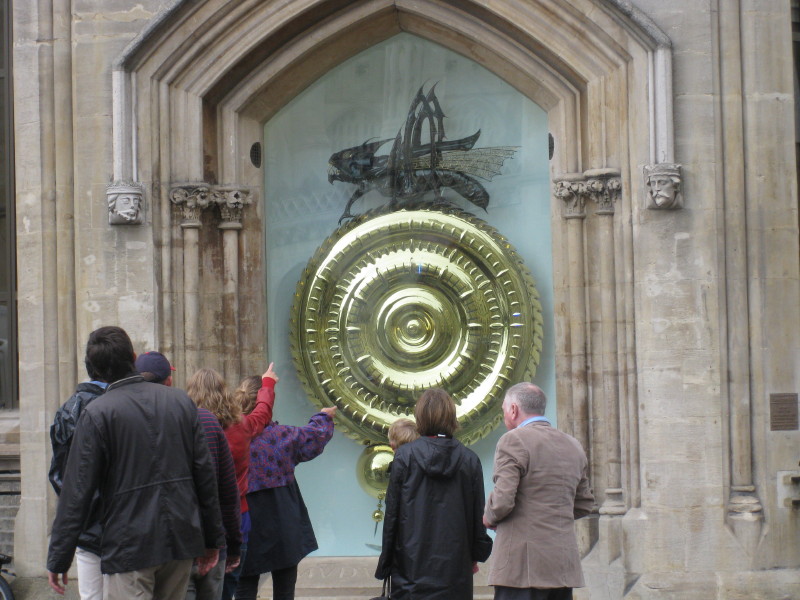
One of the biggest tourist attractions, this clock, designed by Dr. John Taylor at a cost of over £1 million, has no hands or numerals but indicates the time using blue lights focused through different slits in the face. The lights, controlled by the escape wheel, move in concentric circles pausing to indicate the hour, minute and second.

The clock strikes the hour with the sound of a chain dropping into a coffin to symbolise mortality.

It also plays tricks with the observer, creating the illusion of pausing, running unevenly and even going backwards. All this is done mechanically rather than by computer.

The design was inspired by the early English clockmaker John Harrison who invented the so-called 'grasshopper escapement' mechanism which is usually hidden inside the clock itself.


On interesting story was about Magdalene College--which is pronounced 'maudlin'. From 1972, the previously all-male colleges in Cambridge started admitting women with full status, the first being Clare College and King's College. Magdalene made the controversial decision in 1986 to admit women and go co-residential. When women eventually joined the college in 1988, male students protested by wearing black tie, black arm-bands and flying the college flag at half-mast. They also floated a coffin down the River Cam. In 1881, women gained the right to take the Tripos examinations, and were offered University certificates if they passed--not in a graduation ceremony: these were mailed to them.

Wren Library


We were lucky enough to have time to race over before closing time to see the Wren Library inside. They only allow 15 people at a time inside and they are only open from 12:00-2:00 pm. Inside are glass topped display tables with famous books and manuscripts. We saw one of A.A. Milne's original books (he and his son Christopher both attended Trinity College at Cambridge). Sir Isaac Newton's own copy of his Mathematical Principles of Natural Philosophy, 1687, was there with corrections in his own hand for his second edition. The display also contained a lock of his hair, a pocket watch and his walking stick.

I was especially impressed with the Winchester (or Trinity) illuminated Gospels from the early 11th century. It is one of the best examples of the style of illumination which was practiced in Anglo-Saxon England from 950-1066. Known as Winchester School style, its hallmarks are strong colors and a lavish use of gold. Ever since reading People of the Book, I have really been able to marvel at these illuminated books.

The other two things that wowed me were the first folio edition of Shakespeare's comedies, histories and tragedies from 1623 and a 1731 letter from Jonathan Swift with directions to his butler, cook and footman.

Chuck was impressed with Ludwig Wittgenstein's (1889-1951) notebooks and Bertrand Russell's (1872-1970) letter on the implications of the atomic bomb. Wittgenstein is often claimed to have inspired two divergent schools of Philosophical thought: logical positivism, and ordinary language philosophy. Early in his career, he devised plans for a jet engine. Russell held almost every possible Philosophical position in his very long and illustrious career. He was a pacifist--until WWII--for which Sidney Hook declared him an "intelligent pacifist" while an intolerant Vietnam generation often called him a hypocrite.

Inside the Wren Library


We ended our time with lunch at the Eagle Pub.

Chuck's lunch: Eagle Platter, classic pub lunch with Melton Mowbray pork pie, hand carved ham, organic baguette, mixed salad, apple and a selection of pickles.


I had a pasta with grilled vegetables.

Nature and nature's laws lay hid in night;
God said "Let Newton be" and all was light.
~ Alexander Pope