Monday, April 26, 2010

Berlin On Foot


By Claire
Our journey into the city this morning was smooth as silk. We left Homer at 7:35 am and were in line at the Reichstag by 8:20. The Reichstag is the Parliamentary Building and this was one of the top things on my list of things to see in Berlin. Rick Steves gave excellent advice about arriving at 8 am or after 9 pm. We lucked out—well, I sped to the end of the line just in front of a tour group—and a rope was pulled across just behind us, cutting off the tour group. The wait was only about 15 minutes and then a group of about 30 of us was herded in to strip down and go through the security check. It was pretty funny when, as the last people, we were now told to hurry, the elevator was waiting, as we struggled back into our jackets, grabbed our bags, and squeezed in.

Reichstag Dome


We arrived at the top of the building on the bottom level of the dome. Free audio guides were handed over (the entry is free as well) and we were directed onto the ramp that spiraled up and around the dome. I liked the fact that the number of people in the dome was kept to a small number. Just as we set foot on the ramp, our audio guides automatically came to life. The narrator breezily described all that we were seeing, told us when to stop and look, when to move on, now take a couple of steps, etc.

I was really impressed with this structure. It stands for transparency and openness in parliamentary democracy, giving everyone an equal right to share in political life. Looking up at the top of the dome I realized it was open to the air. Then, the audio guide explained that it had an environmentally-friendly cone-shaped funnel beneath it. The funnel helps with air circulation, drawing hot air out of the legislative chamber (ha ha) and pulling in cool air from below.


The funnel has 360 mirrors deflecting daylight as well as an anti-glare shield for the plenary chamber below.


The 360° view was fantastic and somewhat reminiscent of the view from the top of the De Young Museum in San Francisco. All of a sudden you can see the layout of the entire city. In fact, now we could see the whale on the top of the Frank Gehry building.


We spent about an hour there, then decided to walk to the Checkpoint Charlie Museum. We noticed a number of interesting sights along the way.

Café with blankets—I love this idea!


Open space
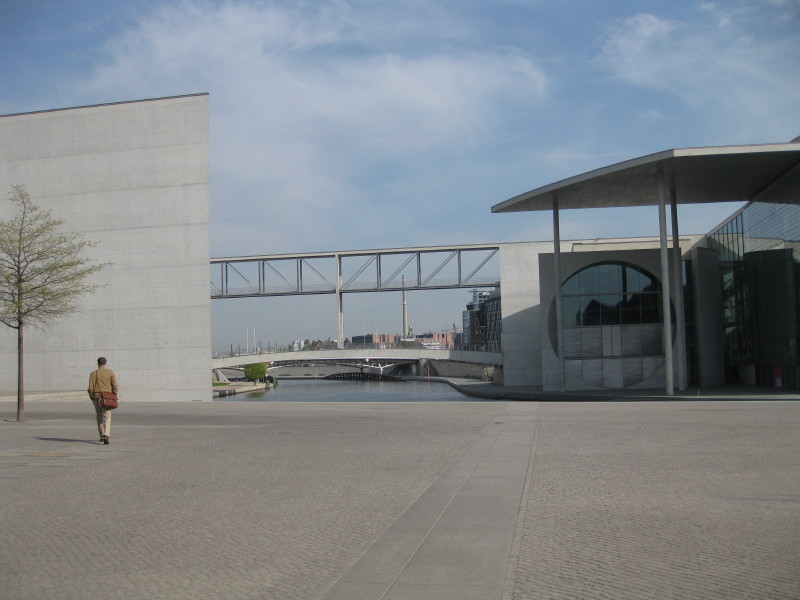

Reflection of Parliament Building


Seeing a tour group enter the museum, we decided to sit it out in a café across the street. Two cappuccinos and a breakfast treat, and we were ready to go.

German croissant—a little heavier than a French one but equally good


Inside the museum, we felt a little bogged down by all the posters with photos attached that required endless hours of reading. Instead, we made our way to the exhibits of successful escapes. It’s astonishing what people will do to escape from imprisonment, even at the risk of their lives.

This car got 5 people out. It had some armor in the windshield and the rear window and the doors were lined with cement.


In this shopping bag, a four year old child was smuggled out from the GDR to West Berlin on a subway leaving East Berlin’s Friedrichstrasse railway station. The mother was granted a short-term permit for leaving the country; but the child had to be left behind. She lived separated from her husband; he would never have consented to allowing the child to be resettled outside the GDR.


A 25 year old GDR woman managed to escape in these two hollowed surfboards in 1987. A Stuttgart shop mechanic, whom she married afterwards, smuggled her out. The two surfboards, with her hiding inside, were brought out of the country on the roof rack of a Renault Fuego.


Most cars were thoroughly inspected at the GDR border. This 1964 Isetta, considered too small to smuggle anyone out, was the only car exempted from the controls. The engine is no larger than a cooking pot and it occupies only one side. The air induction manifold and heating system were taken out. The exhaust pipe was led directly to the underside of the car. The splash-guards over the two wheels were removed and instead a metal frame was installed which, lined with plywood, was capable of carrying one person.


I enjoyed seeing this museum again. There are many harrowing stories of tunnel escapes, homemade balloon flights, and even children taken from parents and put up for adoption when they were caught trying to escape. My first visit was in 1989 when the wall was still up. In fact, the weekend I was there, the last escapee was shot and killed. This was just two months before they opened the wall.

Outside, we found the double row of cobbles tracing the former path of the wall. These cobbles run through the city, even through some modern buildings.


We found the S-Bahn and made our way to the Sony Center with plans to see the German Film Museum but alas, it was closed today. I always forget what day it is and Mondays are terrible for seeing museums; maybe tomorrow. In the meantime, I am heartily sick of big cities and public transportation systems. Our transfer point, Friedrichstrasse, is like an airplane terminal with vast distances to cover before finding your next train, usually up one or two flights, half a kilometer down a corridor and then down a flight. They even have grocery stores, department store style shops and restaurants. In spite of this transport, we must be walking miles each day. On the plus side, when we’re inside, I feel like I’m sitting in someone’s living room. The lighting is subdued, the seating plush, and the ride smooth and silent.


Civilization is a movement and not a condition, a voyage and not a harbor. ~ Arnold Toynbee

Swampland Germany

April 25, 2010
By Chuck
Berlin, etymologically, means swampland; it was built on marshes and has a high water table. That was my first clue that my fantasies about the city might not be realized. Or, maybe it was the trip into the city that set the tone; it was reminiscent of Athens: Take the metro only to find out that you must transfer because part of the line is shut down; you find this out when you are the only people left on the train! Fortunately, a combination of questioning, perseverance and kindly German strangers were sufficient to enable us to finally reach our destination—the start of an overview walking tour of Berlin. We finally arrived at the meeting point after taking: bus, U-Bahn, bus, S-Bahn. This was a 1.5 hour trip; coming home took even longer—U-Bahn, bus, bus, U-Bahn, bus; but, the process was quite similar—only the transfer points were changed. This was much longer than we were led to believe it would be. We are hoping that the lines will be open again, tomorrow, and there will be fewer transfers. Pray for us.

On the bright side, Hotel and City Camping Berlin is on a canal in a wooded area, quiet and serene and even has modern, desirable bathrooms. We enjoyed the sunset last night.


Jacob [J=Y; a is short vowel sound], our Original Berlin Walks guide, has an MA in History in Germany—I think these things count for more over here; so, I was impressed. We wanted to compare this service with the Sandeman's New Europe city tours we have used in Amsterdam, Paris and Prague. I'd say it was a wash; but, the business model is different: Sandeman's is free; but you tip what you believe is fair. Original Berlin Walks are fee-based: With our double discount for owning a Rick Steves book and producing it and the Berlin Welcome Card, we paid only €8 each for this 4 hour tour. This ended up being a bargain.

We were blessed with a lovely, sunny day, which always helps; we hope the prediction of rain for tomorrow is typical of weather reporting reliability—we are really enjoying not having to turn on the heater before we get up in the morning.

One of the first remarks by Jacob was to inform us—and startle me—that the country of Germany only began in 1871. I often forget that the current form of Europe is relatively recent. I had always thought of a very young US, as compared to an older (more mature?) Europe. Now, the cultures of the European continent go back a very long time; but our American form of government has been around longer than that of most current European nations.

Interestingly, much of the tour was in what used to be East Berlin. Brandenburg Gate, the center of old Berlin, was a disappointment as a monument; but, I did enjoy the history surrounding it. This was the most important—and only surviving—of 14 city gates: It was the one through which the emperor entered the city. Conquering Napoleon entered through this gate, then sent the statue on top, The Goddess of Peace, to Paris. A few years later, the Prussians defeated him and brought it back as the Goddess of Victory.


I was fascinated to look from East to West and see an amusement park operating on the other side: There was a Ferris wheel and a giant crane that lifted people into the air. The platz in front of the Gate had the usual tourist phenomena: boring mimes, including a Native American in authentic (I suppose) dress and two gentlemen: one dressed in green—the other in red—suit and bowler. I have no idea what they represented. Note that tourism is a major city industry!

Several of the main museums are conveniently co-located on Museum Island. Two of these have important artifacts “borrowed” from other ancient cultures: The famous 3,000 year old bust of Egyptian Queen Nefertiti—“the most beautiful woman in Berlin”—and the fantastic second century B.C. Greek Pergamon altar. I have looked forward to seeing some of the “missing” items from Greece, Turkey and Egypt in museums in Paris, London and Berlin.

New Museum


Columns surrounding New Museum--there were obvious bullet holes from WW II, deliberately preserved by the Germans as a reminder.


Berlin Cathedral


The Germans are, surprisingly to me, rather uncreative in their naming of public buildings: There is the Berlin Cathedral, the Old Museum, the New Museum, and much more. This is the land of Goethe, for goodness' sake. But their naming process has evolved in the area of Nazi history, which has become an acceptable subject of study: Many countries have Holocaust Memorials; the Germans are facing their past, now, and have a “Memorial to the Murdered Jews of Europe.” [Separate memorials are planned for other victimized groups targeted by the Nazis.] I heartily applaud this trend; I wonder if we US citizens would be so reflective, were our roles reversed. This memorial is thought by some to be reminiscent of the old Jewish Cemetery in Prague, where—due to limitations of space—there are multiple layers of bodies in the cemetery. Add in the course of time, allowing the variously-sized headstones to display at different heights and angles and you have this modern memorial in Berlin. Its site selection was based solely on location, location, location—it is in a very heavily trafficked area.


There is an interesting story about the construction of this site. The architect wanted the memorial to be provocative of reflection about the Holocaust and the memorial; in fact, there is absolutely minimal description of the site or its purpose; and he wanted to permit graffiti to be written onto the blocks; this would allow the public to discern what contributors were actually thinking. The Jewish community thought this would be inappropriate. So, it was determined to make the blocks graffiti-proof with a chemical. But, it turned out, after the implementation, that the chemical had been provided by the German company that had produced Zyklon B during the Nazi extermination program. They did provide their current product for the memorial free of charge; but, it was a most unpleasant irony for some. A further irony is that they discovered the bunker of Joseph Goebbels under one corner of the memorial grounds during construction.

Hitler’s bunker is buried under a parking lot, not far away. The idea is to prevent Neo-Nazis from having sites around which to create shrines. For a convincing portrayal of the final days of the Third Reich, view Bruno Ganz as Hitler in the movie Downfall.

Soviet apartment blocks with location of Hitler’s bunker under the grassy area


Humboldt University was the home of many famous students: Karl Marx, Vladimir Lenin, the brothers Grimm and over two dozen Nobel Prize winners—including Max Planck and Werner Heisenberg, I believe. Einstein taught here until he decided to turn his part time gig at Princeton into a full time position, escaping the Nazis.


Neue Wache, the Emeror’s New Guardhouse from 1816, was once a memorial to the victims of Fascism. After the fall of the Wall, it was transformed into a national memorial “to the victims of war and tyranny.” It houses the tombs of the unknown soldier and the unknown concentration camp victim under Käthe Kollwitz’ statue of Mother with Her Dead Son.


A major disappointment, for me, was the Berlin Wall and Checkpoint Charlie. There is a section of wall remaining—probably more, but that is all I saw; that was fascinating. But, everything about Checkpoint Charlie is a re-creation: therefore unreal; this bothered me. It seemed lacking in history and embodied the worst elements of pandering to tourists. But, we will return tomorrow; Claire has strong memories of her visit 21 years ago—just before the wall fell. Maybe a closer look at the museum will change my perspective.


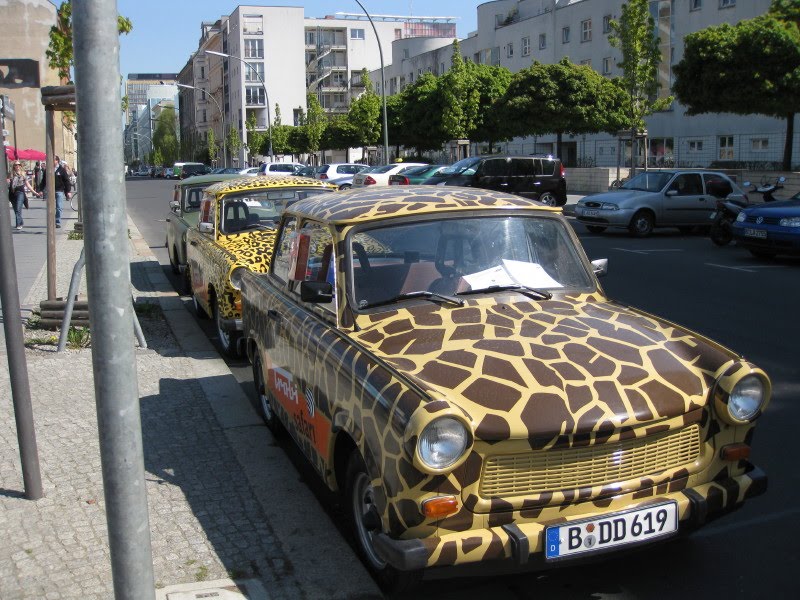
Trabants are East German products that have been recycled as tourist vehicles—the few that remain in service!


The architecture of Berlin is a disappointment. But, we are comparing it with Prague, an utterly fantastic city, and are not allowing for the fact that there was very heavy bombing here during WWII. Besides, we have not seen it all; maybe we missed a lot. Some of the buildings have been torn down: Either they were demolished, run-down, or they were politically incorrect. There is currently a great deal of construction going on and the cultural center of Berlin is returning to its former glory.


Decorative remnant of the Soviet, now Russian, Embassy


Frank Gehry Building. He wanted it to be a whale, was told it was inappropriate, so he put the whale design on the roof. You can just see the flukes.


Upper Eastside Berlin—Funny how the former East Berlin is now the upscale side


New construction--it's everywhere!


Nazi Air Ministry, converted to Communist administrative building, converted to current Finance Ministry


Mural on the former Nazi Air Ministry Building


TV tower


Unter Linden Strasse—Berlin’s answer to the Champs-Elysées—they built this boulevard, planted a bunch of Linden trees and creatively named it Unter Linden Strasse


Bebelplatz was the site of a notorious book burning by staff and students in 1933.


These walking tours, however wonderful, are simply exhausting. Today’s turned out to be 4.5 hours, in addition to 3 hours of travel time, we finally staggered back to Homer with a ten minute walk from our last bus.


When you start by burning books, you’ll end by burning people. ~ Heinrich Heine, 1820

Thursday, April 22, 2010

Czeching out of Prague


By Claire
Prague has exceeded our expectations and that's hard to do. They were set high but nothing can prepare you for the enormity of delights in this city. Our only problem? Navigating on foot. It's hard to figure out which direction you are heading when surrounded by so many buildings. We often set off in the opposite direction from what we intended, got lost, then completely turned around. And this was while using a map! Asking for help was often our only salvation.

So what do you do on your last day? For us, it was a stroll through everything we hadn't seen and of course, food and drink. We started in Malá Strana (the Little Quarter), where we stumbled upon a lovely, quiet garden, the Vojanovy Sady. Once an orchard planted in 1248, it was opened to the public in 1954 and named after leading Czech actor Eduard Vojan.

Vojanovy Sady


From there, we strolled through the windy streets to the John Lennon wall. When he was killed in 1980, a large wall was spontaneously covered with memorial graffiti. The police painted over the "All You Need Is Love" and "Imagine" graffiti again and again which popped up day after day. Finally, when independence came in 1989, people gathered here. This is a wall that is remembered as a place that gave hope to locals craving freedom. There is even what looks like a nice café, The John and George, but we weren't quite ready for food yet.


We made our way across Kampa Island, through the lovely park and came upon these very strange giant baby sculptures. Their faces were scrunched into what looked like a bar code. Interesting.

Kampa Island


Crossing over one of the many bridges over the Vltava River we wound our way towards Wenceslas Square and The New Town. One of us spotted The Louvre Café and we decided maybe it was time for an early lunch.

Louvre Café


I had my eye on a broth full of vegetables but then I spotted a Havana on the menu. This was described as a sundae consisting of coffee and chocolate ice cream, egg liqueur, caramel, whipped cream and a wafer.


Chuck became so discombobulated when he heard me ordering, he couldn't figure out what to do. "But I thought you were ordering lunch!" I told him it was our last day and when I see a coffee sundae, I just have to have it. I suggested he check out the daily special baked goods and he swiftly chose the apple strudel with vanilla sauce and whipped cream with shaved nuts.


Oh, we also each ordered a cappuccino.

Fortified, we took off for Wenceslas Square.


Wenceslas is the "good king" of Christmas carol fame. He was the "wise and benevolent 10th century Duke of Bohemia." He was literate and well-educated; he Christianized his nation; he had the foresight to ally with Saxony, which gave Czechs a vote and political clout when the Holy Roman Emperor was selected. He was murdered in 929 and then canonized. He is a symbol of Czech nationalism. The four other national patron saints on the statue are associated with books, learning and culture rather than military power. What a concept!

We opted for a Rick Steves Walking tour out of his Prague guidebook but took our time and ogled the architecture. The day was perfect with bright blue sky and just the right warm temperature. Starting at the St. Wenceslas Statue, we read that this is a popular meeting place where people say "Meet you under the tail."


Just down from the St. Wenceslas statue is a memorial to two young men who immolated themselves in 1969--a month apart--to stoke the fires of independence. They hoped to inspire people to work for freedom.


Grand Hotel Europa


This building is from the Communist era (hideous, isn't it?) Between 1994 and 2008 it was home to Radio Free Europe.


We found our way into a grand mall called Lucerna Gallery with some Art Deco from the 1930s. Our favorite, though, was a sculpture--called Wenceslas Riding an Upside-Down Horse--hanging like a swing from a glass dome. It was created by David Černý, one of the Czech Republic's most original contemporary artists.


We hurried over to see the Mucha Museum Building, one of Prague's best Art Nouveau sights. I wasn't impressed with the building but I loved the doorway.


Our rush was to meet up with my former boss from 28 years ago, Dave, and his wife, Suzy who are here in Prague. They are my inspiration for this trip. When Dave retired in 1984, and Suzy 2 years later, they bought a VW camper in Amsterdam and traveled through Europe for 11 months. They stored the camper in Europe and returned several times for periods of 3 to 6 months at a time. If they hadn't done that trip, Chuck and I wouldn't be doing this trip.

Our trips overlapped by this one day. We met them at their perfectly located hotel, Hotel Golden Age. It was so good to see them! What a treat for us. They weren't even sure their plane would make it, due to the Iceland volcanic ash issue. We walked down the street to a cute café that Chuck and I had spotted just before we got to their hotel. Two hours sped by way too fast but we had to get back to Homer and get ready for our drive to Berlin tomorrow.


Promise me you'll always remember: You're braver than you believe, and stronger than you seem, and smarter than you think. Christopher Robin to Pooh ~ A. A. Milne